QA • Medical Imaging

DICOM Metadata Validation for Cardiac Image Post-Processing

Duration: 4 months • Role: QA Lead

Led the Quality Assurance and compliance validation for a medical imaging platform, ensuring strict adherence to DICOM standards for reliable medical data exchange and storage.

Context

The project focused on validating a medical imaging system’s ability to correctly process, store, and exchange images across different modalities (CR, DX, PET, RT). Using the DICOM PS3.1 and PS3.11 standards as a benchmark, the goal was to ensure that the system could handle complex SOP Classes and Media Storage Application Profiles without data loss or header corruption.
Healthcare Interoperability (HL7/DICOM) DICOM Protocol Validation SOP Class UID Verification

Primary Risks Identified

  • Header Mismatches: Critical metadata (SOP Class UIDs) being incorrectly mapped, leading to imaging display errors.
  • Interoperability Gaps: Failure to read media storage from different vendors due to non-compliance with PS3.11 profiles.
  • Data Integrity: Potential loss of patient or modality-specific information during the transfer between clinical systems.
  • Schema Evolution: Ensuring the system remains compatible with newer DICOM supplements while maintaining legacy support.

Testing Approach

We implemented a multi-layered validation strategy centered on the DICOM Data Dictionary and Information Object Definitions (IODs) to ensure clinical safety and data reliability.

  • Automated Header Validation: Developed scripts to parse DICOM tags and verify SOP Class UIDs against the PS3.6 Data Dictionary.
  • Interoperability Benchmarking: Conducted cross-platform testing to ensure images stored on various media formats (per PS3.11) were retrievable by third-party viewers.
  • Negative Testing: Injected corrupted or non-standard headers to verify the system’s error-handling and data rejection logic.
  • Metadata Consistency Checks: Ensured synchronization between the DICOM header and the database (e.g., Patient ID, Study Instance UID).

DCMTK Python (pydicom) JIRA SOP Class UID Orthanc IOD Specifications

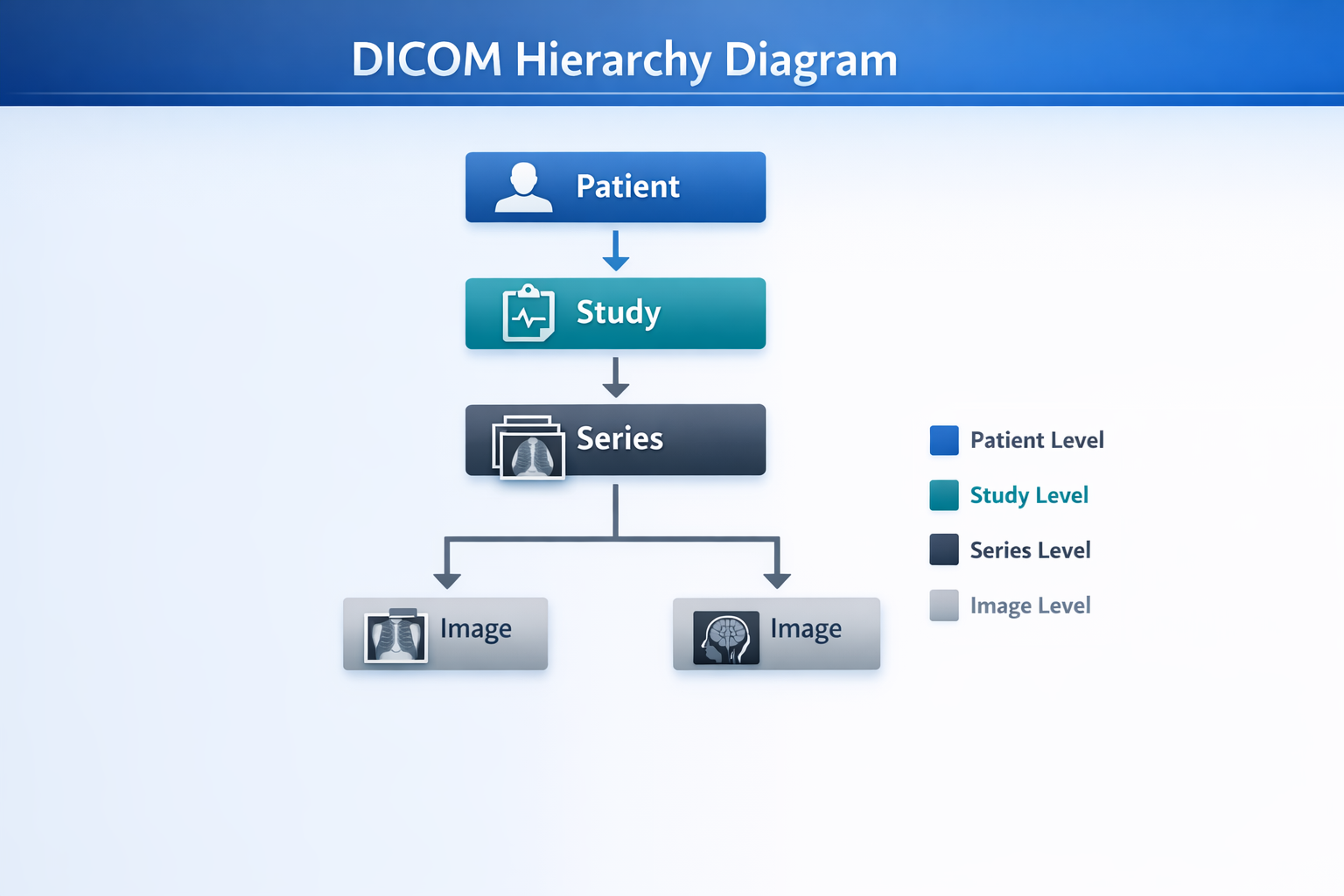
DICOM Hierarchy Diagram

Portfolio logo

Outcome

The validation process identified over 50 high-severity compliance issues before the software reached clinical trials, significantly reducing the risk of diagnostic errors.

  • 100% Compliance: Achieved full validation for all targeted SOP Classes (Radiography, PET, RT).
  • Improved Interoperability: Ensured seamless data exchange with major PACS vendors.
  • Standardized Workflow: Established a repeatable DICOM validation framework for future software updates.
  • Clinical Confidence: Provided documented evidence of interoperability for regulatory submissions.

Key Lessons

In medical software, quality is not just about functionality-it is about strict adherence to global standards. Validating the "hidden" metadata is just as critical as testing the visual UI for clinical accuracy.

  • Healthcare Interoperability requires meticulous attention to standards implementation
  • DICOM's extensibility is both a strength (custom SOP Classes) and risk (fragmentation)
  • Medical Device Regulation compliance directly ties to standards implementation
  • Legacy System Support often conflicts with modern standards adoption
  • Clinical Context determines which SOP Classes are mission-critical vs. optional

Have a system like this?

If you have no idea of testing your current system, let's talk through what's actually going on.

Contact me