Frequency Domain • Medical Imaging

Advanced Frequency-Orientation Analysis of Brain MRI for Concussion Detection

Duration: 19 months • Role: Research Assistant

This project focused on applying Polar and Stockwell Transform based spectral analysis to diffusion MRI data to identify subtle, region-specific changes in white matter microstructure associated with Concussion.

Context

The goal was to move beyond conventional imaging metrics and explore frequency- and orientation-sensitive biomarkers capable of distinguishing concussion patients from healthy controls across multiple recovery timepoints. This work was conducted as part of a imaging study analyzing multiple regions of interest (ROIs) within the corpus callosum (genu and splenium, left/center/right).

Frequency Analysis Orientation Sensitivity White Matter Microstructure

Primary Risks Identified

  • False signal attribution: High-frequency spectral changes risk being misinterpreted as pathology when driven by acquisition noise or preprocessing artifacts.
  • ROI misalignment and partial volume effects: Small spatial inconsistencies can significantly distort angular spectra, especially in tightly packed white-matter regions.
  • Sample size imbalance across timepoints: Drop-off in longitudinal data (e.g., fewer patients at 2M or EOS) introduces bias if not explicitly accounted for.
  • Reproducibility risk: Frequency-domain methods are sensitive to parameter choices; without strict validation, results don't survive replication.

Validation Approach

Given the sensitivity of spectral methods and the clinical implications of concussion research, validation focused on effectiveness, consistency, and interpretability, not just statistical significance.

  • Control benchmarking: Established baseline radial and angular spectra using negative and positive control cohorts to define expected frequency and orientation distributions.
  • Cross-ROI consistency checks: Verified that observed trends were anatomically plausible across symmetric ROIs (left/center/right comparisons).
  • Longitudinal stability testing: Tracked spectral evolution across recovery phases to differentiate transient injury effects from persistent alterations.
  • Statistical confidence validation: Used mean ± standard error and 95% confidence intervals to ensure trends were not driven by outliers or sample imbalance.

Stata R Timeline Analysis BL, 72h, 2W, 2M, EOS Trendline Spectral Heatmap
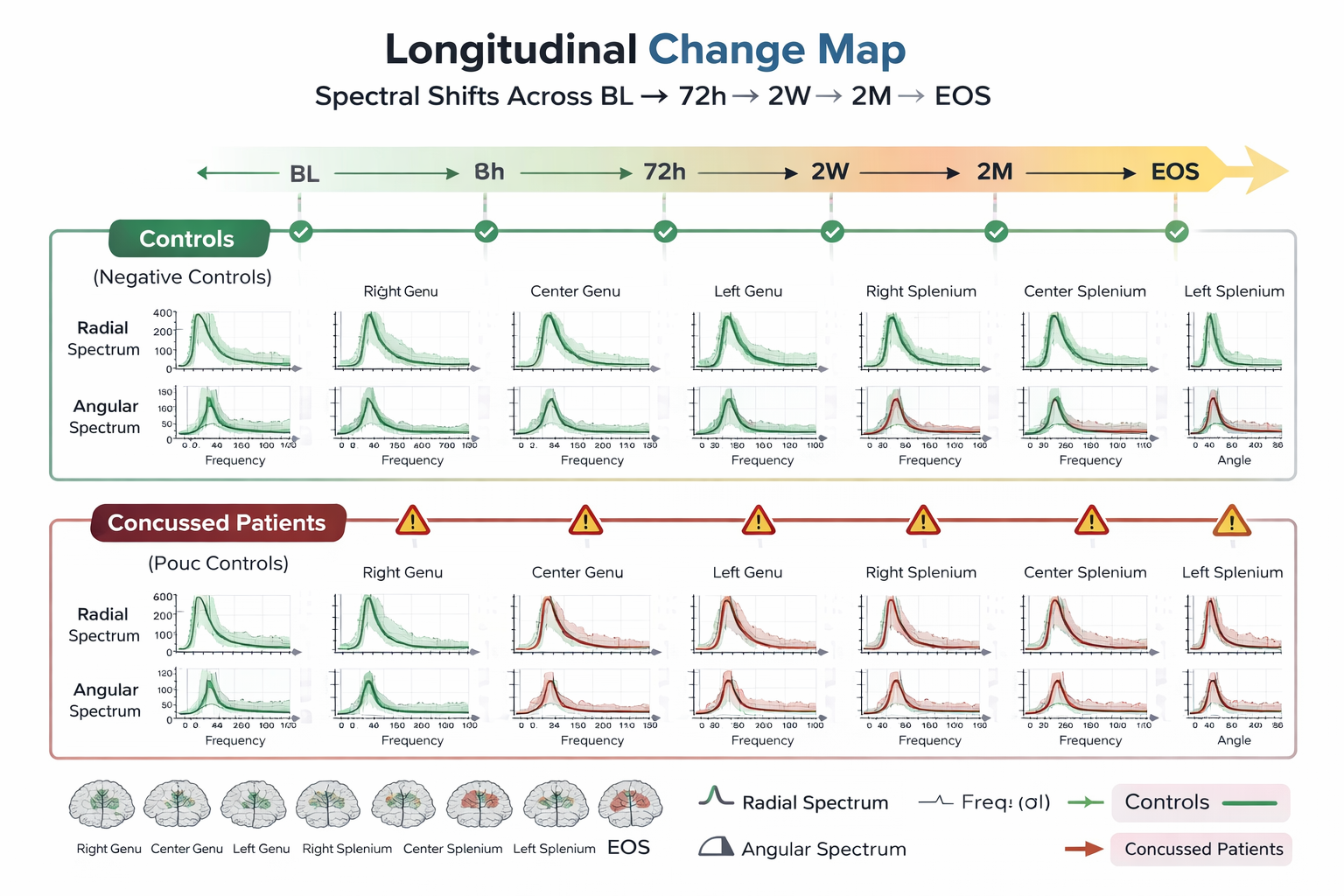
Longitudinal Change Map

Portfolio logo

Outcome

The validation process identified over 50 high-severity compliance issues before the software reached clinical trials, significantly reducing the risk of diagnostic errors.

  • Identified distinct spectral patterns differentiating concussed patients from controls across multiple ROIs.
  • Demonstrated time-dependent normalization trends in some patients, supporting recovery-linked microstructural changes.
  • Established frequency- and orientation-based metrics as sensitive complements to traditional diffusion measures.
  • Produced high-resolution visualizations enabling expert-level interpretation of complex MRI data.

Key Lessons

In medical software, quality is not just about functionality-it is about strict adherence to global standards. Validating the "hidden" metadata is just as critical as testing the visual UI for clinical accuracy.

  • Advanced methods amplify both signal and mistakes Frequency-domain analysis punishes sloppy preprocessing-discipline is essential.
  • Longitudinal data exposes weak assumptions fast Time breaks fragile models; that's a feature, not a bug.
  • Controls are not optional-they are the anchor Without rigorously defined controls, spectral differences are just noise with confidence intervals.
  • Interpretability is a quality requirement If you can't explain what changed and why, you haven't finished the work.
  • Clinical relevance beats mathematical elegance A beautiful transform is useless if clinicians can't interpret or trust it.

Have a system like this?

If you have no idea of testing your current system, let's talk through what's actually going on.

Contact me